Math : méthode statique atan2()
Baseline
Widely available
Cette fonctionnalité est bien établie et fonctionne sur de nombreux appareils et versions de navigateurs. Elle est disponible sur tous les navigateurs depuis juillet 2015.
La méthode statique Math.atan2() retourne l'angle dans le plan (en radians) entre l'axe des abscisses positif et le rayon partant de (0, 0) vers le point (x, y), pour Math.atan2(y, x).
Exemple interactif
function calcAngleDegrees(x, y) {
  return (Math.atan2(y, x) * 180) / Math.PI;
}

console.log(calcAngleDegrees(5, 5));
// Sortie attendue : 45

console.log(calcAngleDegrees(10, 10));
// Sortie attendue : 45

console.log(calcAngleDegrees(0, 10));
// Sortie attendue : 90
Syntaxe
Math.atan2(y, x)
Paramètres
Valeur de retour
L'angle en radians (compris entre -π et π, inclus) entre l'axe des abscisses positif et le rayon partant de (0, 0) vers le point (x, y).
Description
La méthode Math.atan2() mesure l'angle θ dans le sens trigonométrique, en radians, entre l'axe des abscisses positif et le point (x, y). Notez que les arguments de cette fonction passent d'abord la coordonnée en ordonnée, puis la coordonnée en abscisse.
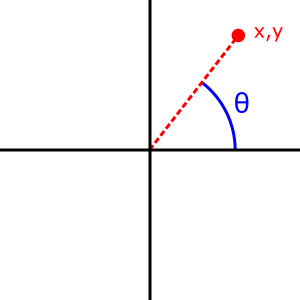
Math.atan2() reçoit séparément les arguments x et y, tandis que Math.atan() reçoit le ratio de ces deux arguments. Math.atan2(y, x) diffère de Math.atan(y / x) dans les cas suivants :
x |
y |
Math.atan2(y, x) |
Math.atan(y / x) |
|---|---|---|---|
Infinity |
Infinity |
π / 4 | NaN |
Infinity |
-Infinity |
-π / 4 | NaN |
-Infinity |
Infinity |
3π / 4 | NaN |
-Infinity |
-Infinity |
-3π / 4 | NaN |
| 0 | 0 | 0 | NaN |
| 0 | -0 | -0 | NaN |
< 0 (inclus -0) |
0 | π | 0 |
< 0 (inclus -0) |
-0 | -π | 0 |
-Infinity |
> 0 | π | -0 |
| -0 | > 0 | π / 2 | -π / 2 |
-Infinity |
< 0 | -π | 0 |
| -0 | < 0 | -π / 2 | π / 2 |
De plus, pour les points situés dans les deuxième et troisième quadrants (x < 0), Math.atan2() renverra un angle inférieur à ou supérieur à .
Parce que atan2() est une méthode statique de Math, vous l'utilisez toujours comme Math.atan2(), et non comme méthode d'un objet Math que vous auriez créé (Math n'est pas un constructeur).
Exemples
Utiliser la méthode Math.atan2()
Math.atan2(90, 15); // 1.4056476493802699
Math.atan2(15, 90); // 0.16514867741462683
Différence entre Math.atan2(y, x) et Math.atan(y / x)
Le script suivant affiche toutes les entrées qui produisent une différence entre Math.atan2(y, x) et Math.atan(y / x).
const formattedNumbers = new Map([
  [-Math.PI, "-π"],
  [(-3 * Math.PI) / 4, "-3π/4"],
  [-Math.PI / 2, "-π/2"],
  [-Math.PI / 4, "-π/4"],
  [Math.PI / 4, "π/4"],
  [Math.PI / 2, "π/2"],
  [(3 * Math.PI) / 4, "3π/4"],
  [Math.PI, "π"],
  [-Infinity, "-∞"],
  [Infinity, "∞"],
]);

function format(template, ...args) {
  return String.raw(
    { raw: template },
    ...args.map((num) =>
      (Object.is(num, -0)
        ? "-0"
        : (formattedNumbers.get(num) ?? String(num))
      ).padEnd(5),
    ),
  );
}

console.log(`| x     | y     | atan2 | atan  |
|-------|-------|-------|-------|`);

for (const x of [-Infinity, -1, -0, 0, 1, Infinity]) {
  for (const y of [-Infinity, -1, -0, 0, 1, Infinity]) {
    const atan2 = Math.atan2(y, x);
    const atan = Math.atan(y / x);
    if (!Object.is(atan2, atan)) {
      console.log(format`| ${x} | ${y} | ${atan2} | ${atan} |`);
    }
  }
}
Le résultat est :
| x     | y     | atan2 | atan  |
|-------|-------|-------|-------|
| -∞    | -∞    | -3π/4 | NaN   |
| -∞    | -1    | -π    | 0     |
| -∞    | -0    | -π    | 0     |
| -∞    | 0     | π     | -0    |
| -∞    | 1     | π     | -0    |
| -∞    | ∞     | 3π/4  | NaN   |
| -1    | -∞    | -π/2  | π/2   |
| -1    | -1    | -3π/4 | π/4   |
| -1    | -0    | -π    | 0     |
| -1    | 0     | π     | -0    |
| -1    | 1     | 3π/4  | -π/4  |
| -1    | ∞     | π/2   | -π/2  |
| -0    | -∞    | -π/2  | π/2   |
| -0    | -1    | -π/2  | π/2   |
| -0    | -0    | -π    | NaN   |
| -0    | 0     | π     | NaN   |
| -0    | 1     | π/2   | -π/2  |
| -0    | ∞     | π/2   | -π/2  |
| 0     | -0    | -0    | NaN   |
| 0     | 0     | 0     | NaN   |
| ∞     | -∞    | -π/4  | NaN   |
| ∞     | ∞     | π/4   | NaN   |
Spécifications
| Specification |
|---|
| ECMAScript® 2026 Language Specification # sec-math.atan2 |
Compatibilité des navigateurs
Voir aussi
- La méthode statique
Math.acos() - La méthode statique
Math.asin() - La méthode statique
Math.atan() - La méthode statique
Math.cos() - La méthode statique
Math.sin() - La méthode statique
Math.tan() - La fonction CSS
atan2()